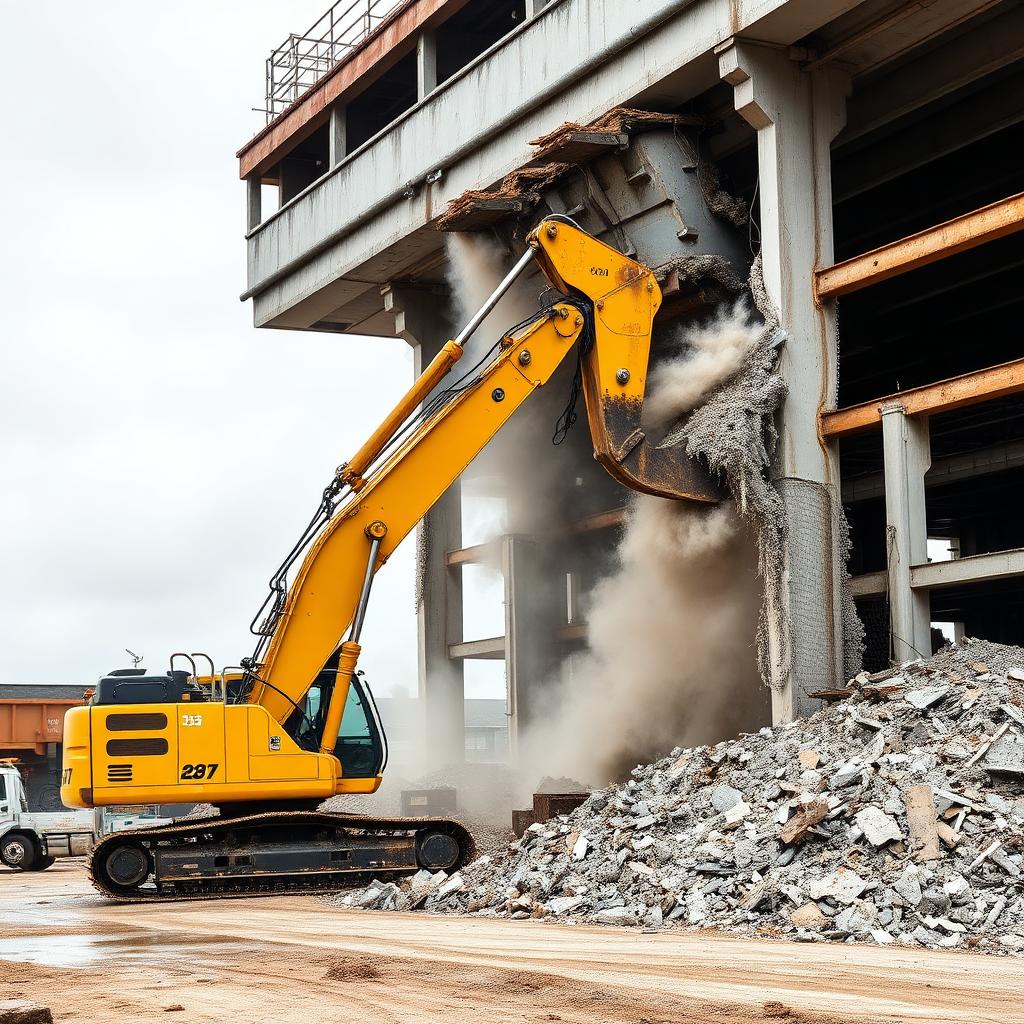
Lead, silica and mercury on commercial demolition projects in Ontario
Lead, silica and mercury rarely make headlines on a commercial demolition, but they shape the schedule, the crew's controls and where the debris ends up. In Ontario these are designated substances, and on demolition they are disturbed in bulk: whole walls, slabs and lighting systems come out at once. This guide is for owners, developers and general contractors planning commercial or industrial demolition in the GTA. It explains how these materials are identified before work starts, what each one typically means on site, and how the findings change the order of work.
For the full list of designated substances and what owners need to know in general, see our page on designated substances in Ontario.
Why designated substances matter more on demolition
A renovation usually disturbs a defined area: a suite, a floor, a run of ceiling. Demolition disturbs everything in the zone, including materials that were sealed behind finishes for decades. Concrete is broken, painted steel is cut and fixtures are pulled out by the hundreds. That means more material, more dust and more waste to sort.
It also means surprises cost more. If a material is found halfway through a structural take-down, work in that area stops until it is assessed and handled. The way to avoid that is to know what is in the building before the demolition plan is finalised.
The designated substances list in plain terms
Under Ontario's Occupational Health and Safety Act (OHSA), eleven substances are designated: acrylonitrile, arsenic, asbestos, benzene, coke oven emissions, ethylene oxide, isocyanates, lead, mercury, silica and vinyl chloride. Most of these are tied to specific industrial processes. In commercial and industrial buildings slated for demolition, the ones that come up most often are asbestos, lead, silica and mercury.
The owner is expected to identify designated substances present at the project and share that information with contractors before work is tendered. Asbestos has its own regulation, O. Reg. 278/05, which governs how asbestos work is classified and carried out.
PCBs are not on the designated substances list, but they are regulated separately and often turn up in the same places as mercury, so a good pre-demolition survey covers them too.
Hazardous materials survey vs hazardous building materials assessment
Owners hear several names for the same basic step: a designated substance survey, a hazardous materials survey, a pre-demolition survey or a hazardous building materials assessment. In every case, a qualified assessor inspects the building, takes samples where needed and sends them to an accredited lab. The report tells you what is present, where and in what condition.
For demolition, the survey usually needs to be broader than for a renovation. It should cover areas that will be destroyed rather than just opened, including concealed spaces, roofing and structure. Our hazardous building materials assessment service is how Sofisa coordinates that work with a qualified assessor and lab. If your project is a renovation or fit-out rather than a demolition, our blog on the designated substance survey for commercial renovation covers that case.
Lead on commercial demolition
Lead is most often found in older paints and coatings, especially on structural steel, doors and frames, and industrial equipment supports. It is not usually a problem while the coating is intact. It becomes one when coated surfaces are cut, ground, sanded or torch-cut, because those methods create lead dust or fume.
On a demolition scope, the survey findings decide how coated elements are taken down. That can mean choosing mechanical cutting over hot cutting, removing coatings at cut lines first, using dust controls and respiratory protection, and keeping lead-bearing debris separate where disposal rules require it. The controls are set from the findings and the method, not from a one-size checklist.
Silica: concrete, masonry and a silica control plan
Crystalline silica is found in concrete, block, brick, mortar and many stone products. Breaking, cutting, drilling and crushing these materials releases fine dust. On commercial and industrial demolition, where slabs, foundations and masonry walls come out, silica is often the hazard that affects the most work hours.
A silica control plan sets out how dust will be controlled for each task: wet methods, tools with dust extraction, enclosures where needed, respiratory protection and housekeeping that avoids dry sweeping. It belongs in the demolition programme from the start, because the methods chosen for slab and masonry removal decide which controls apply.
Mercury and PCBs: lamps, ballasts and switches
Mercury in commercial buildings is mostly found in fluorescent and HID lamps, some thermostats and older switches and gauges. Mercury is a designated substance, so these items are removed intact before strip-out rather than crushed with general debris.
Older fluorescent fixtures can also contain ballasts with PCBs. Before demolition, lamps and ballasts are taken out, sorted and sent for handling as regulated waste. On large floor plates and high-bay warehouses this is a real task in its own right, and it needs to be finished before ceilings and lighting runs come down.
Asbestos: usually the first thing out
In most older commercial buildings, asbestos is the material that sets the schedule. It can be in drywall joint compound, plaster, floor tiles, ceiling tiles, pipe and duct insulation and fireproofing. Under O. Reg. 278/05, asbestos work is classified as Type 1, Type 2 or Type 3, and Type 3 work usually involves a notice to the Ministry of Labour before it starts. See our blog on Type 3 asbestos notice timelines for what that means for lead time, and our asbestos abatement services for how removal is handled.
Sequencing: survey, removals, clearance, demolition
The order of work is what keeps a demolition safe and on schedule:
- Survey and lab results. A qualified assessor confirms what is present in each area.
- Plan. Findings are mapped against the demolition scope: which materials will be disturbed, which controls apply and what has to come out first.
- Removals. Asbestos abatement, lamp and ballast removal, and any other hazardous material removal happen before general demolition in each area.
- Clearance. Where required, a qualified third party confirms the area is ready.
- Demolition. Interior or structural demolition proceeds, with silica and lead controls built into the methods.
Because Sofisa carries out Type 1–3 asbestos abatement as well as commercial demolition, both can run on one contract and one schedule, without handing the site between separate trades. Permits are a separate track; our guide to commercial demolition permits in Ontario explains what is usually involved.
What to ask your demolition contractor
- Have you reviewed the hazardous materials survey against the demolition scope?
- Which materials must come out before demolition starts in each area?
- How will lead-coated steel be cut, and what controls apply?
- What is the silica control approach for slab and masonry removal?
- How are lamps, ballasts and other regulated waste removed and tracked?
- Is the abatement on the same contract and schedule as the demolition?
This article is general information, not legal advice. Confirm requirements with a qualified consultant or the Ministry of Labour, Immigration, Training and Skills Development.
Frequently asked questions
Which designated substances come up most on commercial demolition in Ontario?
In commercial and industrial buildings, the ones met most often are asbestos, lead, silica and mercury. Asbestos is common in older finishes and insulation, lead in older coatings, silica in concrete and masonry, and mercury in lamps, thermostats and switches.
Is a hazardous materials survey needed before demolition?
Owners are expected to identify designated substances before construction work is tendered, and a survey by a qualified assessor is the usual way to do it. For demolition, the survey normally needs to be broader than for a renovation. Confirm the requirements for your project with a qualified consultant.
How is lead paint handled when steel is demolished?
The survey identifies which coatings contain lead. The demolition method is then chosen to limit dust and fume, for example mechanical cutting instead of torch cutting or removing coatings at cut lines, with dust control and respiratory protection.
What is a silica control plan?
It is a plan that sets out how silica dust will be controlled for each task that cuts, breaks or crushes concrete and masonry. It typically covers wet methods, dust extraction, enclosures, respiratory protection and housekeeping.
What happens to fluorescent lamps and PCB ballasts before demolition?
They are removed intact before ceilings and lighting are demolished, sorted and sent for handling as regulated waste. Mercury lamps should not be crushed with general debris.
Planning a commercial or industrial demolition?
Send us the building details and any survey you already have. We'll review the hazardous materials against the demolition scope and plan the sequence on one contract.