Commercial water damage restoration and flood rebuild in Toronto, Mississauga & the GTA.
Commercial and industrial property only — offices, retail, clinics, warehouses and multi-unit commercial buildings.
After the water is out and the building is dry, somebody has to put it back. That is the part Sofisa does — stripping out what the water ruined and rebuilding the interior, on commercial and industrial properties across Toronto, Mississauga and the GTA.
We work alongside your drying contractor, your insurer and your property manager, and we handle the demolition, the framing, the drywall and the finishes.
- WSIB clearance — Good Standing (Clearance ID D0000JZAHE)
- $5M general liability insurance
- One contract, senior supervision
After a flood — next steps
The order matters. Rebuilding over material that is still holding moisture is how the same wall gets opened twice.
Water out
Stop the source and get standing water out of the building.
Dry
Drying and dehumidification, handled by a drying contractor — that half is not ours.
Strip
Saturated drywall, insulation, ceilings and flooring come out and leave site.
Mould check
Where growth has started, remediation happens before anything is closed up.
Rebuild
Framing, drywall, ceilings and finishes, handled on the same contract.
Flooded property in Toronto or Mississauga? Request a quote. Where growth has already started, see mould remediation and removal; the walls and ceilings go back as work handled on the same contract drywall and framing.
Where we fit in a water damage job
A commercial water loss runs in two halves. The first is emergency response — extraction, drying, dehumidification — and that is a separate trade with separate equipment. We do not do that half, and we will tell you so on the phone.
The second half is renovation and restoration: taking out the materials that cannot be saved, remediating any growth that started, and rebuilding the interior to what it was. That half is ours, and it is usually the larger part of the claim and the part that decides when the space reopens.
What the reconstruction scope covers
- Strip-out of water-damaged drywall, insulation and vapour barrier
- Ceiling tile, grid and drywall ceiling removal
- Flooring, underlay and adhesive lifted off the slab
- Doors, frames, millwork and casework removed where saturated
- Mould remediation where growth has started
- Moisture mapping with meters and thermal imaging before the removal line is set
- Framing assessed, cleaned or replaced
- Rebuild of partitions, ceilings, doors and finishes
- Photographs and written scope for the insurance file
 01
01What we get called out to
Storm and surface flooding
Water entering at grade or through the envelope during heavy rainfall. Below-grade and ground-floor commercial space takes the worst of it, and the damage runs further up the wall than the tide line suggests.
Burst and failed supply lines
A line lets go over a weekend and runs for two days before anyone finds it. Damage spreads laterally along the floor assembly and downward into the space below.
Sewer and drain backup
Category 3 water. Porous materials it touched come out rather than get dried, and the removal scope is wider than clean-water damage of the same area.
Roof and envelope failure
Shows up as ceiling staining, but the insulation and deck above have usually been wet far longer than the visible mark suggests.
Sprinkler discharge
Clean water, large volume, fast. Often the fastest job to put back, because the material is saturated but not contaminated.
Long-running slow leaks
The ones that produce mould rather than a flood. No dramatic event, just a cavity that has been damp for months.
Insurance work and documentation
Most of this is insured work, and the file matters as much as the build. We photograph conditions before anything is touched, record what is removed, and write the scope so strip-out and reconstruction are separate line items rather than one number.
Where there is an adjuster's scope already, we price against it and flag anything we think is missing before the work starts, not after. For what moves the number before any of that, see what drives commercial water damage restoration cost in the GTA.
For the full process — water categories, the strip, dry and rebuild sequence, occupied buildings, mould and older stock — read our guide to commercial water damage restoration in Ontario.
Where mould comes into it
Water that sat long enough produces growth, and closing a wall over it means opening it again later. Where that has happened, the work carries into mould remediation — containment under negative pressure, HEPA filtration, and air clearance testing before anything is rebuilt.
In older buildings, materials disturbed during strip-out can also contain asbestos. Where a survey identifies it, abatement is sequenced first, and the reconstruction is handled on the same contract drywall and framing on the same contract.
How a restoration rebuild runs
Site walk and scope
we walk it with you, your adjuster or your property manager, record what is affected, and mark what comes out versus what stays.
Written scope and price
a fixed-scope, line-item quote with strip-out and reconstruction shown separately so the insurance file can carry both.
Strip-out
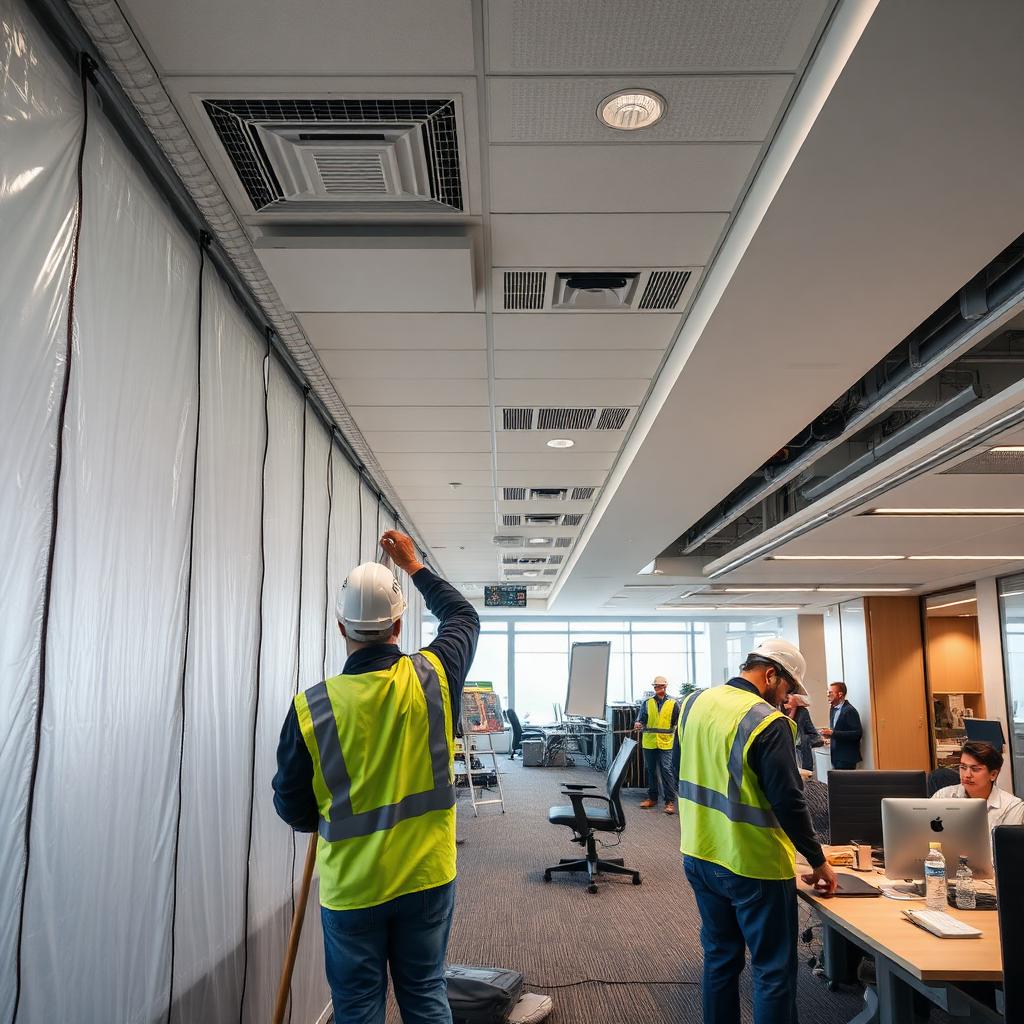
damaged materials removed and taken off site, with the work area separated so the rest of the building keeps operating.
Remediation where needed
where the water sat long enough for growth, mould remediation is done before anything is closed back up.
Rebuild
framing, drywall, ceilings, doors and finishes, handled on the same contract, back to the condition the space was in.
Water damage restoration questions
Peel building types, occupied-unit sequencing and the rebuild that follows are set out on water damage restoration in Mississauga. Downtown and midtown floors, freight-window haul-off and after-hours strip-out are covered on water damage restoration in Toronto. Airport-adjacent industrial, Queensway condo bays and plaza retail in west Toronto are covered on water damage restoration in Etobicoke. Highway 410 and Airport Road industrial-office, warehouse floods and plaza retail are covered on water damage restoration in Brampton. Highway 7 and Vaughan Metropolitan Centre office suites, Highway 400 warehouse floods and Woodbridge plaza retail are covered on water damage restoration in Vaughan, and Halton on water damage restoration in Oakville, and York Region east on water damage restoration in Markham, and Halton west on water damage restoration in Burlington.
Do you do emergency water extraction and drying?
No. Extraction, drying and dehumidification are a separate trade and we do not offer them. We come in after the building is dry and handle the strip-out, any mould remediation, and the reconstruction. We work alongside whichever drying contractor is already on site.
What is commercial water damage restoration?
In our part of it: removing the building materials the water ruined, dealing with any mould that started, and rebuilding the interior to the condition it was in before. Drywall, insulation, ceilings, flooring, doors and finishes.
Can you work with our insurance company?
Yes. We document conditions and photograph as we go, and we price strip-out and reconstruction as separate line items so the scope maps onto how a claim is usually structured. We deal with adjusters directly where that speeds things up.
How soon after a flood can you start?
As soon as the building is dry enough to work in and the scope can be confirmed. We check that with moisture meters and thermal imaging rather than by eye — starting reconstruction on materials that are still holding moisture is how you end up doing it twice.
Is mould always part of a water damage job?
Not always. It depends on how long the material stayed wet, what kind of water it was, and the conditions in the space. Where growth has started, remediation happens before the rebuild rather than alongside it.
Can the rest of the building stay open?
Usually. The affected area is separated and access controlled, and the noisy or dusty operations are scheduled to the hours the building allows so tenants and staff in unaffected areas keep working.
Do you handle sewer backup and contaminated water?
We handle the construction side — removing the porous materials that contaminated water reached, and rebuilding afterwards. The removal scope is wider than for clean water because materials that would be dried and kept after a clean-water loss come out instead.
What do you need to give us a price?
The address and the affected area, what caused the water and whether it is stopped, any drying or moisture readings taken, the adjuster's scope if there is one, and whether the space is occupied.
What areas do you cover?
Toronto, Mississauga, Brampton, Vaughan, Etobicoke, Oakville, Markham and the surrounding GTA.
Scopes that usually run on the same contract
Most GTA projects need more than one of these. Running them under one contract with senior supervision keeps the sequence — and the accountability — in one place.
Commercial asbestos abatement
Flood-damaged materials in older buildings can carry asbestos, abated before rebuild.
Commercial asbestos abatementCommercial mould remediation and removal
Where water sat long enough for growth, handled before anything is rebuilt.
Commercial mould remediation and removalCommercial renovation and restoration
The full interior put back after a loss, on one contract with senior supervision.
Commercial renovation and restorationCommercial drywall and framing
Walls and ceilings handled on the same contract across Toronto, Mississauga and the GTA.
Commercial drywall and framingWater out, building stripped? We'll put it back.
- (647) 963-4310
- info@sofisa.ca
- Sofisa Group Inc. · Mississauga, ON