Asbestos abatement company for Type 1, 2 and 3 removal in Toronto, Mississauga and the GTA.
Sofisa is an asbestos abatement contractor for commercial and industrial buildings across Toronto, Mississauga and the GTA. We handle Type 1, 2 and 3 removal on the same contract as the demolition and renovation work we carry out. Abatement is rarely the whole job — it is the scope that has to clear before the rest of the project can start.
Because we handle the demolition and the rebuild on the same contract as well, the abatement scope sits inside one contract and one schedule instead of stalling while a separate contractor is booked.
- WSIB clearance — Good Standing (Clearance ID D0000JZAHE)
- $5M general liability insurance
- One contract, senior supervision
Key takeaways
- Sofisa is an asbestos abatement and remediation contractor for commercial buildings in Toronto, Mississauga and the GTA. It handles abatement and the demolition or renovation after it on the same contract.
- In Ontario, asbestos work on construction projects is classed as Type 1, 2 or 3 under O. Reg. 278/05, and the type sets the containment, equipment and training required.
- Before a project starts, the owner must list the designated substances present, including asbestos (OHSA s. 30). That list goes to bidders.
- Asbestos waste handling and transport are regulated under Ontario's waste rules (Reg. 347).
- WSIB-cleared, $5M general liability insurance, IICRC-aligned. Commercial only.
When abatement comes before demolition or renovation
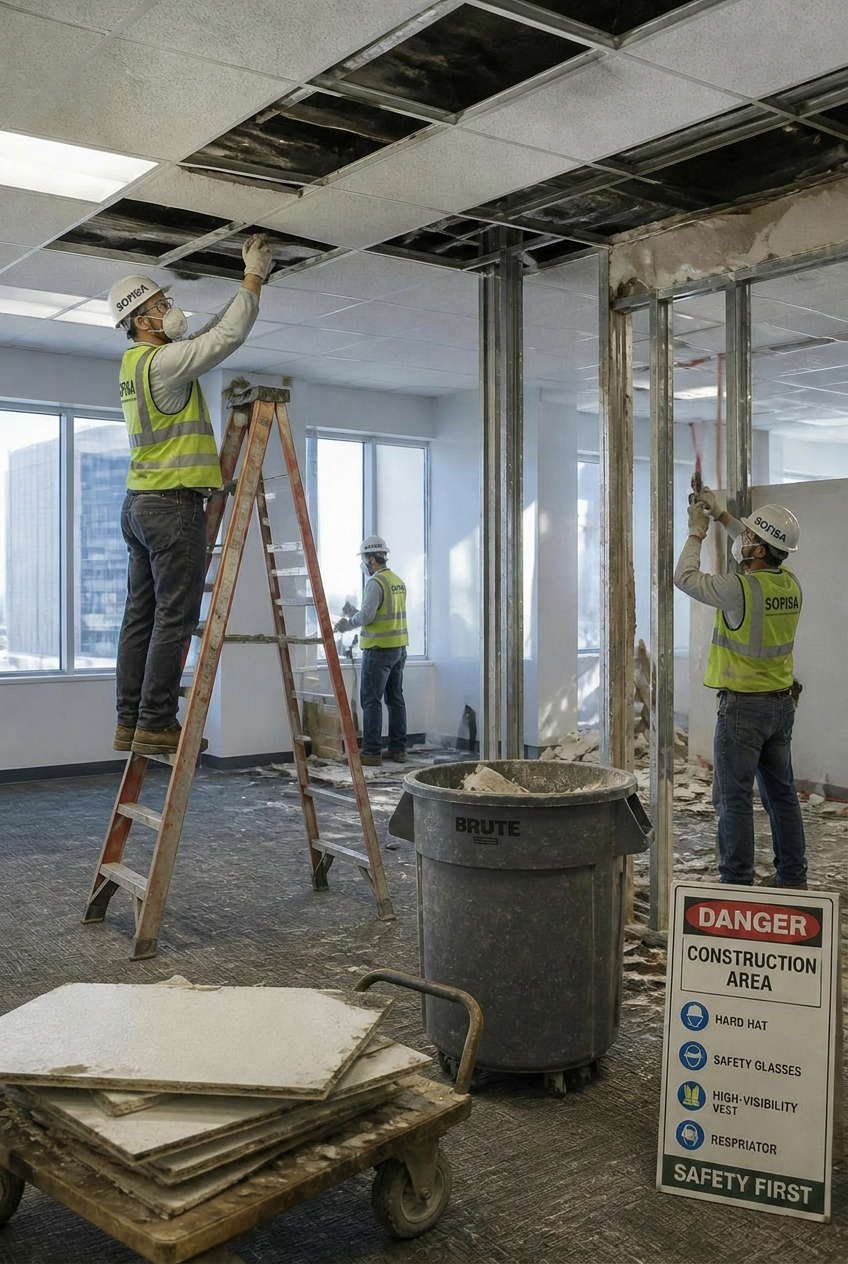
Any commercial building of a certain age can hold materials that have to be dealt with before walls come down or services are opened up. On most projects the sequence is fixed: identify what is there, remove or manage what has to go, confirm the area is ready, then let interior demolition or commercial demolition proceed. For Peel sites, see commercial asbestos removal in Mississauga.
Discovering it late is what turns a two-week strip-out into a two-month one. It is worth resolving before the tender closes, not after mobilization.
Asbestos remediation contractor vs. abatement: same work, different words
They mean the same thing. Property managers search for an "asbestos remediation contractor" and an "asbestos abatement company" interchangeably, and both describe removing or managing asbestos-containing material so the rest of the project can go ahead. In Ontario, what's regulated is the operation itself: O. Reg. 278/05 classes asbestos work on construction projects as Type 1, Type 2 or Type 3, and the type sets the containment, equipment and training. Whatever the scope is called, Sofisa prices it from the owner's survey and the operation type.
Commercial asbestos removal in occupied buildings
Many commercial asbestos removal jobs happen while the rest of the building stays open. The work area is separated from occupied space, access is controlled, and noisy or high-risk stages can be phased after hours where the building allows it. Where air monitoring is required, it is carried out by the owner's consultant, and the work area isn't released until the consultant's criteria are met. Waste is packaged, labelled and transported under Ontario's waste rules (R.R.O. 1990, Reg. 347). Because Sofisa handles abatement, demolition and the rebuild on the same contract, the property manager deals with one schedule instead of three hand-offs.
 01
01Materials that commonly contain asbestos in commercial buildings
Ontario Regulation 278/05 treats a material as asbestos-containing when it holds 0.5 per cent or more asbestos by dry weight. In commercial and industrial stock the materials most often tested include:
- Sprayed fireproofing and thermal insulation
- Pipe, boiler and duct insulation and their fittings
- Vinyl floor tile, sheet flooring and the mastic beneath it
- Ceiling tiles and textured or sprayed ceiling coatings
- Drywall joint compound and some plasters
- Asbestos cement board, panels and pipe
- Gaskets, seals and packing in mechanical equipment
- Roofing felts, membranes and flashing compounds
Age and appearance are not a test. Only a survey and laboratory analysis confirm what a material actually is.
Asbestos abatement company work is typed before it is priced
An asbestos abatement company on a commercial or industrial building prices from the survey and from the type of operation, not from floor area. Ontario Regulation 278/05 treats a material as asbestos-containing when it holds 0.5 per cent or more asbestos by dry weight, and section 12 sorts the work by the risk of fibre release. The regulation does not apply to private residences or to buildings containing four or fewer dwelling units. The owner commissions the survey and gives contractors the written report before tender. Sofisa does not perform the survey. Removal is sequenced ahead of demolition or renovation.
O. Reg. 278/05 — Designated Substance — Asbestos on Construction Projects and in Buildings and Repair Operations, made under the Occupational Health and Safety Act — sorts asbestos work into three types according to the risk of fibre release. Section 12 sets out the classification.
- Type 1 — lower-risk work, such as removing a small area of ceiling tile without cutting it, or handling non-friable material with hand tools while it is wetted
- Type 2 — moderate-risk work, including removing one square metre or less of friable material, enclosing friable material, glove-bag work, and using power tools fitted to HEPA-filtered dust collection
- Type 3 — higher-risk work, including removing more than one square metre of friable material, spray-applying sealant to friable material, and using power tools without dust collection
Which type applies drives the notice, the controls and the sequence, so it is settled at assessment rather than on site. The regulation does not apply to private residences or to buildings containing four or fewer dwelling units — it is a commercial and industrial framework.
What the building owner has to have in hand
This is the part that most often holds up a quote. Under section 10 of the regulation, before an owner requests tenders for demolition, alteration or repair work, the owner must arrange for the material to be examined, must prepare a written report describing the material, its condition and where it is, and must give that report to prospective contractors.
In practice that means the survey is the owner's to commission, and it should exist before the job goes out to bid. Section 8 also requires the owner of certain buildings to keep an asbestos record for the building and to tell occupiers and contractors where the material is.
If material nobody knew about turns up mid-job, section 10 requires the constructor or employer to notify the Ministry inspector, the owner, the contractor and the joint health and safety committee straight away. Work in that area stops until it is sorted.
What to look for in asbestos abatement contractors
Most asbestos abatement contractors can remove material; fewer can run it inside a live commercial project. Start with the designated substances survey — a contractor should price against the survey, not a walk-through guess, and tell you which items are Type 1, Type 2 or Type 3 work under O. Reg. 278/05. For Type 3 work, ask who files the notice with the Ministry of Labour, how the enclosure and negative air will be set up, and who does the clearance air testing before the area is released.
Then check the paperwork: WSIB clearance in good standing, general liability insurance, and a named supervisor on site. Finally, ask whether the abatement sits on the same contract as the demolition and rebuild. When it does, there is no hand-off gap between trades and no second mobilisation.
Planning, containment and the work area
The scope of the controls follows the type of operation. In general terms that means the work area is separated from the rest of the building and access to it is controlled, material is kept wet where wetting is appropriate, and waste is collected in dust-tight containers that are labelled as asbestos waste and cleaned before they leave the area. Polyethylene sheeting and drop sheets used as barriers are not reused.
Notice to the Ministry of Labour is required before Type 3 work begins, and for Type 2 work where a square metre or more of insulation is being removed. That notice is a scheduling item, not a formality — it belongs in the programme. The scheduling effect is covered in our guide to Type 3 asbestos notice timelines in Ontario.
Asbestos waste transport and disposal
Once sealed, labelled containers leave the work area, the waste is still regulated. Ontario's general waste management regulation (Reg. 347) sets how asbestos waste is packaged, labelled, transported and received, and it goes by a carrier to a site approved to accept it — never into a general construction bin.
On a commercial project the waste route is planned with the building — which elevator, which dock and what hours — so bagged material never crosses an occupied lobby or shares a cab with tenants. Disposal is a priced line in the quote, and the waste paperwork goes into the close-out file with the clearance results.
What happens before demolition or renovation resumes
For Type 3 work carried out inside a building, the regulation requires clearance air testing before the enclosure comes down — with an exception where the building is being demolished and will only be entered by the workers doing the demolition. Results have to be posted within 24 hours.
Once the area is released, the rest of the work follows on: interior demolition or commercial demolition, then drywall and framing and interior fit-out. Our own guide, asbestos in commercial buildings built before 1990, covers the background in more depth, and what drives commercial asbestos abatement cost in Ontario explains how a scope like this gets priced. If you are preparing a package, our owner's guide to commercial asbestos abatement in Mississauga and Ontario walks through the survey, the Type 1–3 checklist and what to send for a quote.
What changes the price of an abatement scope
Abatement is priced from the survey and the building, not from floor area. These are the items that move a number the most.
- Type 1, Type 2 or Type 3 classification of the operations involved
- Friable versus non-friable material, and how much of each the survey identifies
- Occupied building versus vacant space, and the containment and access hours that follow
- How complete the designated substance survey is — unknowns get priced as risk
- Notice periods, enclosure build-up and clearance durations before the area can be released
- Waste handling, transport and disposal of designated material
- How the work sequences into the demolition and rebuild that follow it
For the long-form version of the same list, read what drives commercial asbestos abatement cost in Ontario. Where the removal clears the way for a teardown or strip-out, it prices better alongside commercial demolition and commercial interior demolition on one contract. Where a teardown is involved, the Ontario commercial demolition permit process explains what a demo permit requires before strip-out begins.
Send the survey and the building's access rules — or call (647) 963-4310.
What we need to price it
- The designated substance survey or asbestos report for the building
- Drawings or a scope of work for the demolition or renovation the abatement clears the way for
- The building's access hours, occupancy and any shutdown windows
- Where the affected areas are, and what has to keep operating around them
- A site walk
If the survey has not been done yet, say so — it changes the sequence, not whether we can help.
How an abatement scope runs
Review
we read the survey and the project scope, and confirm what has to be dealt with, where, and how it affects the programme.
Quote
a written scope and price covering the abatement, the controls, access hours and disposal, and how it sequences with the rest of the work.
Notice and set-up
required notice given, work area prepared and separated, access controlled before anything is disturbed.
Removal
material removed and containerised, with the controls the classification calls for.
Clear and hand over
area released and the following trades brought in, so the project picks up where the schedule expects it.
Work across Peel Region
Our yard is in Mississauga, so much of our abatement work is in Peel: office, industrial and flex buildings that were built or last renovated before 1990, when vinyl floor tile and mastic, drywall joint compound, ceiling tile, pipe insulation and sprayed fireproofing commonly contained asbestos. Local building types, the survey-before-tender detail and how a removal sequences into demolition and drywall are on our asbestos removal Mississauga page.
Why the survey comes before the tender
Ontario Regulation 278/05 puts the duty on the owner: before demolition, alteration or repair work is tendered, the material has to be examined, a written report prepared, and that report given to the contractors being asked to price the work.
The practical effect is straightforward. With a survey in hand, every bidder prices the same classifications, the same quantities and the same controls, and the abatement duration can be placed in the programme before a schedule is committed to a tenant. Without one, the abatement scope surfaces mid-project, and it surfaces as delay.
If the survey has not been done, tell us at enquiry stage. It changes the order of the work, not whether we can help.
Asbestos removal across Toronto and the GTA
The buildings that generate this work are the ones built before the mid-1980s and renovated several times since — Toronto office towers and midtown commercial blocks, Mississauga industrial and flex space along the Airport Corporate, Dixie and Heartland corridors, plaza retail across Brampton, Etobicoke and Vaughan.
What typically turns up is floor tile and mastic, pipe and duct insulation, sprayed fireproofing above a ceiling, and joint compound in partitions nobody expected to touch. It rarely appears where the renovation is; it appears where the renovation happens to open a wall.
Peel building types, survey-before-tender detail and how a removal sequences into the teardown and the walls sit on our asbestos removal Mississauga page. Once clearance is in hand, the rebuild that follows runs under commercial renovation in Mississauga. Downtown and midtown access, occupied floors and after-hours containment sit on asbestos abatement in Toronto, and the Highway 410 warehouse, Bramalea industrial-office and plaza demising version sits on asbestos abatement in Brampton. Airport and Carlingview industrial-office, Bloor West and Kipling suites and Queensway plaza retail sit on asbestos abatement in Etobicoke, and Highway 7, Concord industrial-office and Vaughan Metropolitan Centre work sits on asbestos abatement in Vaughan, and Halton on asbestos abatement in Oakville and asbestos abatement in Markham and asbestos abatement in Burlington.
Because abatement, commercial interior demolition and commercial demolition run under one contract with senior supervision, the release of an area and the start of the next scope is a decision we make, not a negotiation between two companies. Where a wall opens onto growth rather than asbestos, that is commercial mould remediation.
Asbestos abatement and remediation for Toronto and GTA commercial buildings
On commercial buildings in Toronto and the GTA, asbestos abatement and asbestos remediation are the same O. Reg. 278/05 process — Type 1, 2 or 3 work with the containment, worker protection and waste handling the classification requires. Property managers often search asbestos abatement Toronto or asbestos remediation Toronto; tenders more often say asbestos removal. We classify the material from the designated substance survey before anything is priced, then handle the removal so it sits ahead of demolition and rebuild on the same contract. Crews cover downtown and midtown Toronto floors and Peel commercial stock from the Mississauga yard. Commercial and industrial only — we don't take work on houses or condos.
City detail: asbestos abatement in Toronto and asbestos abatement Mississauga.
Asbestos removal companies versus a GC that handles it on the same contract
Hiring a stand-alone asbestos removal company means a second schedule between abatement and the strip-out or drywall that follows. Sofisa handles Type 1–3 commercial abatement and also the demolition and framing that come after on the same contract, so one senior supervisor owns the handover. When owners compare asbestos removal companies Toronto against a GC that handles it on the same contract, the practical difference is whether clearance to tear-out is a scheduling call on the same contract or a wait for another firm. We bid commercial GTA scopes either as the abatement package alone or inside the larger renovation.
Asbestos abatement questions
Are you an asbestos abatement company or a general contractor?
Both, and that is the point. Sofisa handles Type 1, 2 and 3 asbestos abatement on commercial and industrial buildings, and also the demolition and the rebuild that follow, on the same contract and one schedule.
When does asbestos abatement need to happen before demolition?
Whenever a survey identifies asbestos-containing material in an area that demolition or renovation will disturb. The material is dealt with first, the area is released, and the demolition follows. Sequencing it any other way is what causes delays.
What information do you need to quote abatement?
The building's designated substance survey or asbestos report, the scope of the demolition or renovation it relates to, the building's access hours and occupancy, and a site walk. The survey is the key document.
We do not have a survey yet. What now?
Under Ontario Regulation 278/05 the owner arranges for the material to be examined and prepares a written report before tendering demolition, alteration or repair work, then gives that report to prospective contractors. If it does not exist yet, that is the first step and it changes the sequence rather than the outcome.
Can abatement be coordinated with interior demolition?
Yes, and it usually should be. Running abatement and demolition under one contract means the handover between them is a scheduling decision rather than a gap between two companies' availability.
What happens after the abatement is finished?
For Type 3 work inside a building, the regulation requires clearance air testing before the enclosure is removed, unless the building is being demolished and only demolition workers will enter it. Once the area is released, the following trades move in.
What is the difference between Type 1, Type 2 and Type 3 work?
It is a classification in section 12 of Ontario Regulation 278/05 based on how likely the work is to release fibres — from lower-risk handling of non-friable material, through moderate-risk work such as glove-bag removal, to higher-risk work such as removing more than a square metre of friable material. The type drives the notice and the controls required.
Does the Ministry of Labour need to be notified?
The regulation requires notice before Type 3 work begins, and for Type 2 work where a square metre or more of insulation is being removed. It is a scheduling item worth allowing for.
Can the building stay in use during the work?
Often, in part. The work area is separated from the rest of the building and access controlled, so adjacent areas can usually keep operating — but what is workable depends on the material, the classification and the building itself, and that gets settled at assessment.
Can this be part of a larger renovation contract?
Yes. Most of our abatement work sits inside a demolition or renovation project rather than standing alone, which is the point — one contract, one schedule, one project manager.
What areas do you cover?
Toronto, Mississauga, Brampton, Vaughan, Etobicoke, Oakville, Markham and the surrounding GTA.
Why does the survey need to exist before tender?
Because without it nobody is pricing the same job. Ontario Regulation 278/05 puts the obligation on the owner to have the material examined and a written report prepared before demolition, alteration or repair work is tendered, and to give that report to prospective contractors. Tenders based on a survey are comparable; tenders based on assumptions turn into change orders.
What if asbestos is found after the work has started?
Work in that area stops, the material is treated as asbestos-containing until it is established otherwise, and the scope is re-sequenced around it. Because we handle the abatement on the same contract, the delay is a scheduling adjustment on the same contract rather than a wait for another contractor to become available.
Do you handle abatement in occupied Toronto and Mississauga office buildings?
Yes, and it is common. The work area is separated from the rest of the building with controlled access, and the schedule is built around the building's hours, elevator windows and tenant notice requirements. What is workable in a given building is settled at assessment, not assumed.
How does abatement affect the overall project schedule?
Mainly through notice periods, set-up, and clearance where it applies — each of those is a known duration that belongs in the programme from day one. Projects lose time when abatement is discovered late, not when it is planned in.
What is the difference between asbestos abatement and asbestos remediation in Toronto?
On commercial Toronto work they describe the same regulated process under O. Reg. 278/05 — Type 1, 2 or 3 removals with the containment, worker protection and waste handling the classification requires. Searchers say remediation; tenders often say removal or abatement. Sofisa prices the classified scope, not the label.
Do you bid as an asbestos removal company or as the general contractor?
Both. We handle commercial asbestos abatement and also the demolition and rebuild that follow on the same contract, so owners can award one contract instead of coordinating a separate asbestos removal company with the GC schedule.
Can one programme cover asbestos removal at sites across the GTA?
Yes. Crews mobilise from Mississauga and run commercial removals across Toronto and Peel under the same methods. What changes between a tower floor and a Peel low-rise is access and haul-off, not who does the work.
What's the difference between asbestos remediation and abatement?
In practice nothing: both mean removing or managing asbestos-containing material. In Ontario the work is regulated as Type 1, 2 or 3 operations under O. Reg. 278/05.
Who is responsible for identifying asbestos before a renovation?
The owner. OHSA s. 30 requires the owner to determine which designated substances are present and list them before the project begins.
Do you handle commercial asbestos removal and the rebuild?
Yes. Sofisa handles abatement, demolition and the fit-out on the same contract, with one schedule.
Do you remove asbestos from houses?
No. Sofisa only takes commercial, institutional and industrial work.
Regulatory references on this page are drawn from Ontario Regulation 278/05 under the Occupational Health and Safety Act. This is general information for planning purposes, not legal or compliance advice — confirm requirements for your project against the current regulation.
Scopes that usually run on the same contract
Most GTA projects need more than one of these. Running them under one contract with senior supervision keeps the sequence — and the accountability — in one place.
Commercial demolition
Structural teardown and full strip-out once the abatement scope is closed out.
Commercial demolitionCommercial interior demolition
Selective strip-out that follows once the abated area has been released.
Commercial interior demolitionCommercial mould remediation
Removal of mould-affected materials, often found once walls are opened up.
Commercial mould remediationWater damage restoration and flood rebuild
The rebuild path after flooding, once damaged and hazardous materials are out.
Water damage restoration and flood rebuildSend the survey. We'll price the abatement.
- (647) 963-4310
- info@sofisa.ca
- Sofisa Group Inc. · Mississauga, ON