Commercial mould remediation and removal in Toronto, Mississauga & the GTA.
Commercial and industrial buildings only — offices, retail, clinics, warehouses and multi-unit commercial property.
Sofisa handles mould remediation in commercial and industrial buildings across Toronto, Mississauga and the GTA — containment, removal of the affected materials, and the reconstruction afterwards, on one contract.
IICRC-aligned practices, with containment held under negative pressure and air clearance testing before anything is closed up. And because we are a construction company, the wall goes back up too.
- WSIB clearance — Good Standing (Clearance ID D0000JZAHE)
- $5M general liability insurance
- One contract, senior supervision
After a flood — next steps
The order matters. Skipping a step is how a wall gets closed over damp framing and opened again three months later.
Water out
Stop the source and get standing water out of the building.
Dry
Drying and dehumidification, handled by a drying contractor — that half is not ours.
Strip
Saturated drywall, insulation, ceilings and flooring come out and leave site.
Mould check
Where growth has started, remediation happens before anything is closed up.
Rebuild
Framing, drywall, ceilings and finishes, handled on the same contract.
Flooded in Toronto or Mississauga and already dried out? Request a quote. See water damage restoration and flood rebuild for the strip-out and reconstruction side, or renovation and restoration where the loss runs wider than one room.
What commercial mould remediation involves
Mould is a symptom. Something let water into the building and it stayed long enough for growth to start, usually somewhere nobody was looking. Remediation means separating that area from the rest of the building, taking out the materials that have been colonised, getting them off site, and making sure whatever let the water in has been dealt with before anything is closed back up.
On a commercial property the removal is rarely the hard part. The hard part is doing it in a building that still has tenants, staff or customers in it, and then putting the space back so it can be used again.
What our mould remediation scope includes
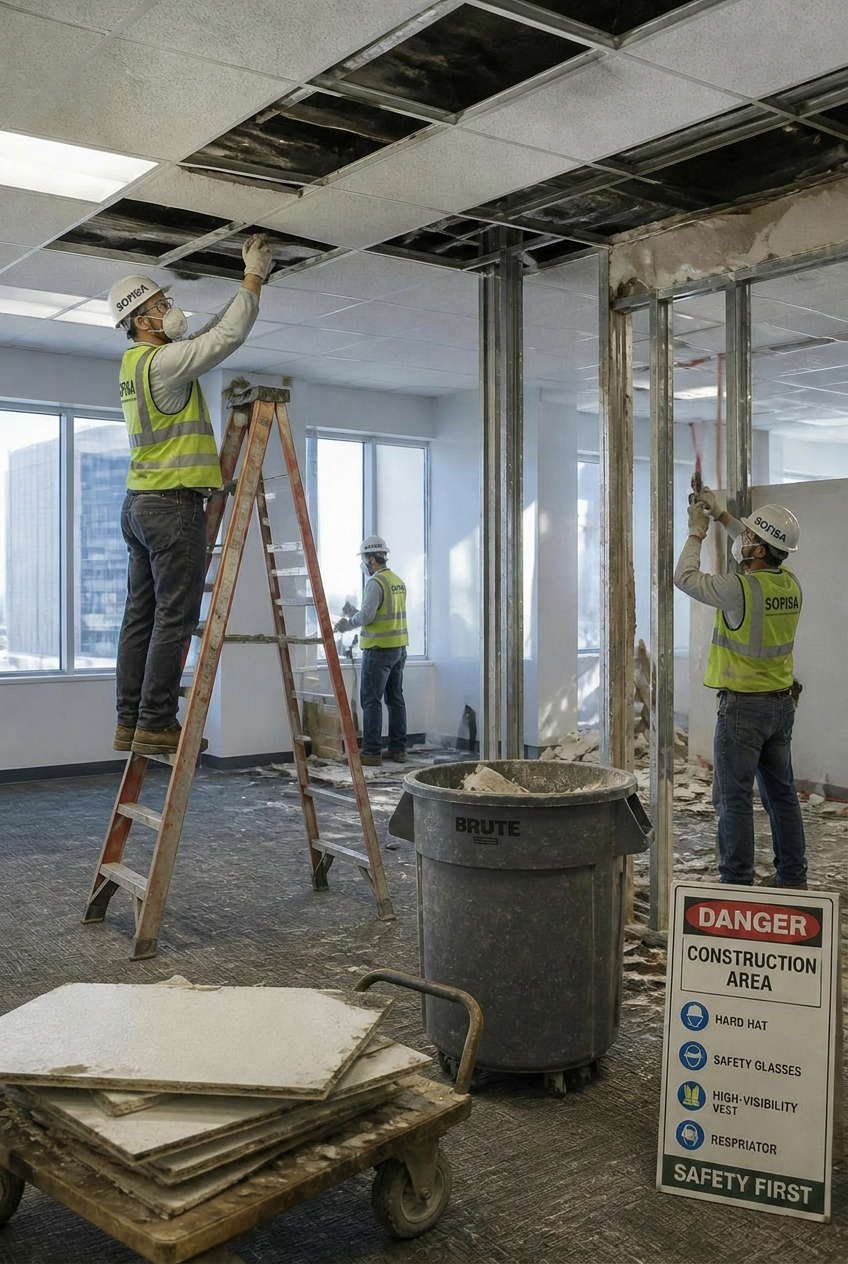
- Containment built around the affected area, held under negative pressure
- HEPA-filtered negative air machines running for the duration of the work
- Removal of mould-affected drywall, insulation and vapour barrier
- Ceiling tile, grid and drywall ceiling removal where affected
- Flooring, underlay and adhesive lifted where water tracked under it
- Affected material bagged and removed from site
- Air clearance testing before the containment comes down
- Framing cleaned or replaced depending on condition
- Coordination with the plumbing or envelope repair that stops the source
- Rebuild of everything removed — framing, drywall, ceilings, finishes
 01
01Where mould turns up in commercial buildings
By the time it is visible it has usually been there a while. These are the places we open up first.
Behind drywall
The most common place we find it. A slow supply-line or envelope leak wets the cavity, and nothing shows on the surface until the paint blisters or the smell arrives.
Under flooring
Water tracks under vinyl, carpet tile and laminate and sits on the slab. The floor looks fine from above while the underlay holds moisture for weeks.
Ceiling tile and grid
A roof or floor-above leak shows up as staining on tile, and the grid and insulation above it are usually wetter than the tile that gave it away.
Mechanical and janitor rooms
Standing humidity, few eyes on the room, and porous materials stored against walls. Problems here run for months before anyone reports them.
Washrooms and kitchens
Failed seals around fixtures, and cavities that never dry between uses. Common in restaurants and in older office washroom cores.
Basements and below-grade space
Ground water and backup flooding leave the affected zone at the bottom of the wall, where the drywall wicks it upward well past the visible line.
Find the water first
There is no point remediating a wall if the thing that wet it is still wetting it. Before we price the rebuild we want to know what the source was and whether it has been repaired — a supply line, a roof or envelope failure, a backup, or condensation from a mechanical problem.
Where the source repair sits with another trade, we sequence around it and confirm it is done before the cavity is closed. Where it is construction work, we do it.
Containment, then removal
The work area is separated from the rest of the building and access to it is controlled, so the disturbance stays where the work is. Affected drywall, insulation, ceiling materials and flooring come out, get bagged, and leave the site.
Framing is assessed rather than assumed — some of it cleans up and stays, some of it is better replaced, and that call gets made with you rather than after the fact.
How we find it, contain it, and prove it is gone
Finding the full extent
Visible growth marks the edge of the problem, not the middle of it. We use moisture meters and thermal imaging to map where water actually travelled through the assembly, so the removal line is drawn on evidence rather than on what the stain looks like. It is routinely wider than the eye suggests.
Keeping it in one room
The work area is sealed and held under negative pressure by HEPA-filtered negative air machines, so air leaves the containment through a filter rather than into the rest of the building. That is what lets a floor keep operating while a unit on it is being stripped.
Proving it is finished
Air clearance testing is carried out before the containment comes down, and the reconstruction does not start until it passes. Post-remediation verification is the difference between a job that is finished and a job that merely looks finished.
Sofisa follows IICRC-aligned mould remediation practices. The equipment and the testing are not extras quoted on top — they are how the work is done, and they are in the price.
The rebuild is where most remediation contracts stop
A remediation firm removes the affected material and hands you a stripped room. Then you go and find a contractor to frame it, board it, tape it, put the ceiling back and paint it — a second procurement, a second mobilisation, and a gap in the middle where nobody owns the schedule.
we handle drywall and framing, so the reconstruction is the same crew and the same contract as the removal. Where the space needs finishes, millwork and fixtures on top of that, it carries straight into an interior fit-out. Where asbestos-containing materials are also present, that is asbestos abatement and it is sequenced before the mould work. Where the mould is one part of a wider loss, the whole reconstruction sits under renovation and restoration.
Working in an occupied building
Most of this work happens in buildings that cannot close. The affected zone gets separated, access routes are protected, and the loud or dusty operations move to the hours the building allows. Tenants and staff get told what is happening and when, because the complaints come from surprise more than from disruption.
Peel building types, occupied-unit sequencing and the rebuild that follows are set out on mould remediation Mississauga, and downtown and midtown towers, negative air on occupied floors and freight haul-off are covered on mould remediation in Toronto, and Highway 410 and Airport Road industrial-office, warehouse washroom blocks and plaza retail are covered on mould remediation in Brampton, and Airport and Carlingview industrial-office, Bloor West and Queensway suites and plaza retail are covered on mould remediation in Etobicoke, and Highway 7 office parks, Highway 400 industrial and Woodbridge plaza retail on mould remediation in Vaughan, and Halton on mould remediation in Oakville, and York Region east on mould remediation in Markham, and Burlington on mould remediation in Burlington.
What we need to quote it
- The address, the affected area and roughly how much of it
- Any inspection, air-quality or adjuster report you already have
- What caused the water, and whether that has been repaired
- Whether the space is occupied and what hours we can work
- Whether you want removal only, or removal plus the rebuild
Pricing is fixed-scope, with removal and reconstruction shown separately so you can see both halves. Send us the details and we will walk it. For what moves the number before we get there, see what drives commercial mould remediation cost in the GTA. For the step-by-step process and the insurance documentation side, read our mold removal Mississauga guide.
Mould remediation questions
Do you handle mould remediation on the same contract, or subcontract it separately?
we handle it. The same company that contains and removes the affected materials does the reconstruction afterwards, under one contract and one project manager.
What does commercial mould remediation actually involve?
Separating the work area from the rest of the building, removing the affected drywall, insulation, ceilings and flooring, getting that material off site, making sure the water source is dealt with, and then rebuilding what came out. On a commercial property the sequencing around occupants and operations is usually the harder half.
Can you do the rebuild as well as the removal?
Yes, and it is the main reason to use us. Most remediation companies stop when the affected material is gone and leave you to find a contractor for the reconstruction. we handle framing, drywall, ceilings and finishing, so the space is handed back finished rather than stripped.
How much does mould remediation cost?
It depends on the area affected, what has to come out, whether the space stays occupied, and how much reconstruction follows. We price it as a fixed scope after walking the site, and we split removal from rebuild on the quote so you can see both.
What causes mould in a commercial building?
Almost always water that was not found or not dried quickly enough — a supply line, a roof or envelope leak, a flood, or persistent condensation. Remediating without fixing that source means doing it again, so the source repair gets confirmed before we rebuild.
Can the building stay open while you work?
Usually. The affected zone is separated and access is controlled, the noisy and dusty operations are scheduled to hours the building allows, and the work is phased so the rest of the floor keeps running.
Do you work with our insurance company?
Yes. We document the scope and photograph the conditions as we go so the file has what an adjuster needs, and we price the removal and the reconstruction separately where that helps the claim.
Do you do air clearance testing after remediation?
Yes. Air clearance testing is carried out before the containment comes down, and we do not begin the reconstruction until it passes. That post-remediation verification is what an insurer, a property manager or an incoming tenant will ask for, and it is part of the scope rather than an add-on.
Are you certified for mould remediation?
We follow IICRC-aligned mould remediation practices. we handle the containment and removal and we handle the reconstruction afterwards, which is the part most remediation firms hand off.
What do you need to give us a price?
The address and the affected area, any inspection or air-quality report you already have, what caused the water and whether it has been fixed, whether the space is occupied, and a site walk.
What areas do you cover?
Toronto, Mississauga, Brampton, Vaughan, Etobicoke, Oakville, Markham and the surrounding GTA.
Scopes that usually run on the same contract
Most GTA projects need more than one of these. Running them under one contract with senior supervision keeps the sequence — and the accountability — in one place.
Commercial asbestos abatement
Older buildings often need asbestos handled alongside the mould scope.
Commercial asbestos abatementWater damage restoration and flood rebuild
Strip-out and reconstruction after a flood in Toronto, Mississauga and the GTA.
Water damage restoration and flood rebuildCommercial renovation and restoration
Where the loss runs wider than one room and the whole interior goes back.
Commercial renovation and restorationCommercial drywall and framing
The trade that rebuilds every wall and ceiling we take out, handled on the same contract.
Commercial drywall and framingRelated resources
Found mould? We'll remove it and rebuild it.
- (647) 963-4310
- info@sofisa.ca
- Sofisa Group Inc. · Mississauga, ON