Mould in commercial buildings: an Ontario property manager's guide to assessment and remediation
Mould in a commercial building is rarely just a cleaning problem. It touches tenant relations, building operations and lease obligations, and if it is handled badly, the reputation of the property. This guide is for property managers, facility managers and owners of office, retail and light-industrial buildings in Ontario. It walks through what to do after the first report, how a mould assessment works, how to talk to occupants, what remediation and clearance involve, and what to keep on file afterwards.
If you need a price rather than a process, our commercial mould remediation cost guide covers what drives the number.
Why mould is a property-management issue
Small patches of surface growth on a hard surface can sometimes be cleaned as routine maintenance. Mould behind drywall, above ceilings or under flooring is different. It usually means materials have to come out, the area has to be separated from the rest of the building, and the work has to be planned around the people who use the space. Those are management decisions: who is told, which areas close, when the work happens and who pays.
Handled early and in order, most commercial mould problems stay contained to the affected area. Handled late or informally, they tend to spread, generate complaints and cost more to fix.
Early signs in offices, retail units and light-industrial space
Mould in an office building or a commercial unit is often found by someone other than the property manager. Common first reports include:
- A persistent musty odour in a suite, washroom or service room
- Stained or bubbling ceiling tiles or drywall
- Discolouration at the base of walls, around windows or behind furniture
- Occupant complaints about air quality or comfort in one area
- Growth found when a contractor opens a wall or ceiling during a renovation
Mould needs moisture to grow, so every report should lead to the same question: where is the moisture coming from? The moisture source must be found and corrected, or the mould will come back after remediation.
Commercial mould inspection vs mould assessment: who does what
The two terms are often used interchangeably, but on a commercial building it helps to separate the roles:
- Inspection is the site walk: looking for visible growth, odour, staining and damp materials, and mapping where moisture is present.
- Mould assessment is the formal evaluation by a qualified consultant: sampling where needed, accredited lab analysis, and a written report that sets the remediation scope and the clearance criteria.
- Remediation is the work itself, carried out by a contractor to the scope in the assessment.
Keeping the assessor independent of the remediation contractor is good practice, because the same report that sets the scope is used to confirm the work is finished. Sofisa is a commercial general contractor and mould abatement contractor, not a lab or consultant. We inspect and map moisture, coordinate a qualified assessor and lab sampling where needed, and carry out the remediation. Our page on mold inspection in Mississauga explains how that works for commercial buildings.
Reading the mould assessment report
A useful assessment report tells you:
- Which areas and materials are affected, and how far the growth extends, including hidden areas
- Which materials have to be removed and which can be cleaned
- The containment and work precautions recommended for the size of the area
- The likely moisture source, if it has been identified
- How clearance will be confirmed before the area is closed up
If the report leaves any of these out, ask the assessor before you tender the work. Contractors can only price and plan to a clear scope.
Mould abatement guidelines in Ontario
Ontario does not have a single mould regulation that sets out remediation methods step by step. In practice, commercial mould remediation follows recognised industry guidelines, such as those published by the Environmental Abatement Council of Canada and the Canadian Construction Association. These guidelines scale the precautions to the size of the affected area, from small areas handled with basic controls to large areas that need full containment, negative air and HEPA filtration.
Employers and building owners also have general duties under the Occupational Health and Safety Act (OHSA) to protect workers, which is one reason remediation is planned rather than improvised. Your assessor will say which level of precautions applies to your building.
Communicating with tenants and occupants
Tenants usually hear about mould before they hear about the plan. Clear, factual communication heads off most of the friction. Good practice includes:
- Acknowledging the report quickly and saying what happens next
- Explaining which areas are affected and whether they will be closed off
- Sharing the timing of the assessment, the remediation and any after-hours work
- Naming one contact for questions
- Confirming when the work is complete and clearance has passed
Check your lease obligations, and get advice where needed, before you make commitments about cause, cost or compensation.
Sick building syndrome and mould: what to say and what not to say
"Sick building syndrome" is a general term for symptoms that occupants link to time spent in a building, usually without one identified cause. Mould is one possible indoor air quality factor, alongside ventilation, temperature, humidity and emissions from materials. It is widely accepted that mould can affect indoor air quality and occupant comfort.
Property managers should not diagnose or reassure on health questions. Refer occupants with health concerns to medical professionals, and let a qualified consultant investigate the building.
Remediation, containment and clearance
Once the scope is set, remediation in a commercial building usually follows the same order:
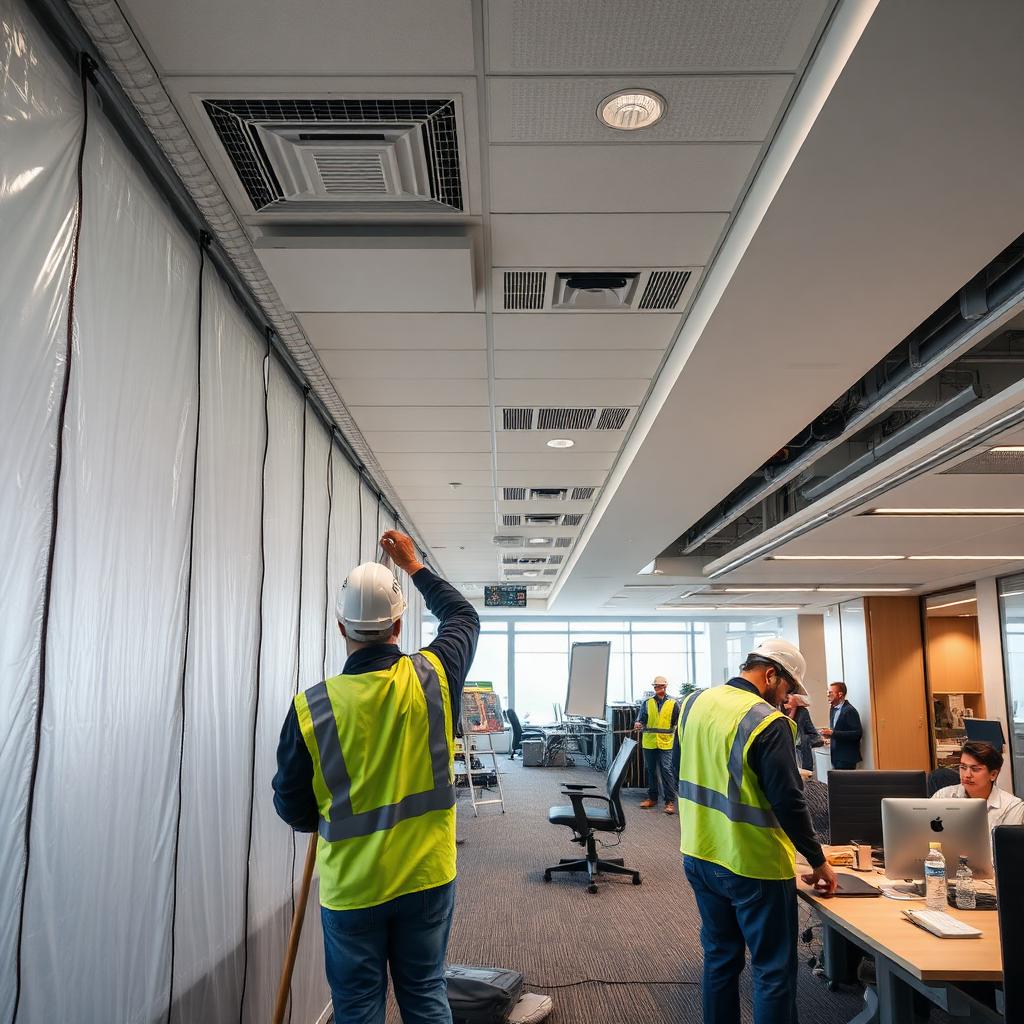
- Containment. The work area is separated from the rest of the building and access is controlled. Larger areas get negative air and HEPA filtration.
- Removal. Affected drywall, insulation, ceilings and flooring are removed and bagged out. Where whole partitions or ceilings have to come out, the work overlaps with interior demolition.
- Cleaning. Remaining surfaces in the work area are HEPA-vacuumed and cleaned.
- Clearance. Visual inspection and, where specified, air sampling confirm the area meets the clearance criteria before containment comes down.
- Rebuild. Removed materials are replaced once the moisture source is confirmed fixed.
Sofisa handles the containment, removal and reconstruction on one contract, and we don't start the rebuild until clearance passes. See our commercial mould remediation services for the full scope, or commercial mould remediation in Mississauga for buildings in Peel.
Records, follow-up and preventing recurrence
Keep one file for each mould event:
- The first report, photos and dates
- The assessment report and lab results
- Tenant notices and correspondence
- The remediation scope, contractor documents and clearance results
- What was done to correct the moisture source
Revisit the area after the repair, and add it to your routine building inspections. If an insurer is involved, our blog on mould removal, documentation and insurance in Mississauga explains what an adjuster usually asks for.
This article is general information, not legal advice. Confirm requirements with a qualified consultant or the Ministry of Labour, Immigration, Training and Skills Development.
Frequently asked questions
What does a commercial mould assessment include?
A qualified consultant inspects the affected areas, takes samples where needed for accredited lab analysis and writes a report. The report identifies the affected materials and their extent, the remediation scope and precautions, and how clearance will be confirmed.
Who should inspect mould in an office building?
The property manager usually handles the first look and the response. A qualified consultant carries out the formal mould assessment, and a remediation contractor does the work to that scope. Keeping the assessor independent of the contractor is good practice.
Are there mould abatement guidelines in Ontario?
There is no single Ontario regulation that sets out mould remediation methods. Commercial work generally follows recognised industry guidelines, such as those from the Environmental Abatement Council of Canada and the Canadian Construction Association, and your assessor will say which level of precautions applies.
Should tenants be told about mould in a commercial building?
In general, clear and timely communication is good practice: what was found, which areas are affected, the timing of the work and a contact for questions. Check your lease obligations and get advice before making commitments about cause or cost.
How is clearance confirmed after commercial mould remediation?
Before containment comes down, the area is checked against the clearance criteria in the assessment, usually by visual inspection and, where specified, air sampling by a qualified consultant. Reconstruction should start only after clearance passes.
Dealing with mould in a commercial building?
Send us the address, the affected area and any assessment you already have. We'll walk the site and scope the remediation and rebuild on one contract.